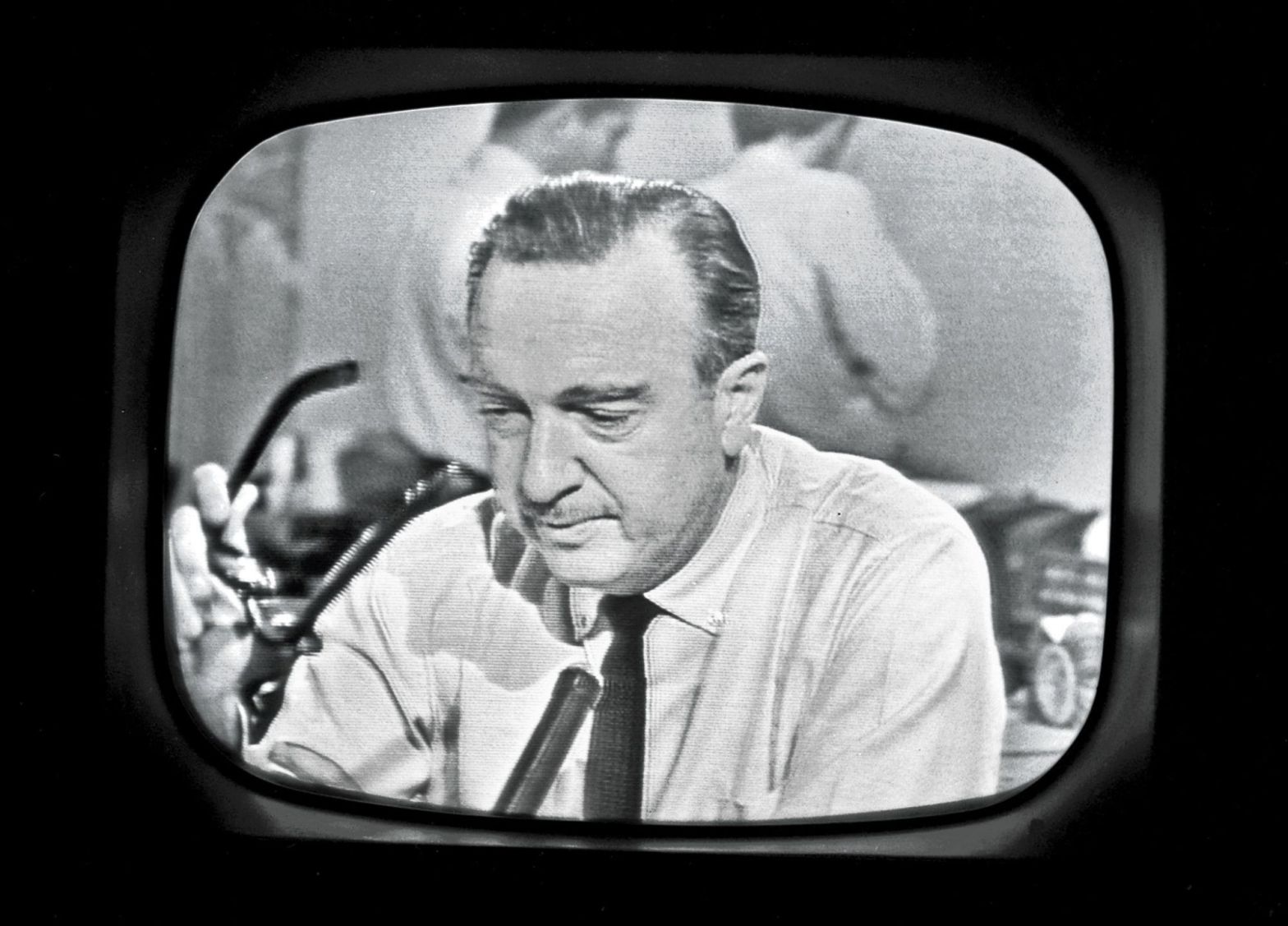
Television was still something of a novelty in the 1960s. The set we had when I was little, was actually a small black-and-white portable—portable only in name, really, since we never moved it from its spot in the family room. What made it stand out was its bright red metal case. I can still picture it clearly in my mind’s eye. The red TV.
Some of my earliest memories come from sitting in front of that TV screen. I watched Romper Room, Dennis the Menace, and reruns of The Little Rascals, mixed in with newer shows like The Jetsons and The Flintstones. I still smile thinking about those old NBC promos: “In living color on NBC.” My sister Carole and I were convinced that meant the show would somehow appear in color—even on our black-and-white TV. The logic of kids.
But for my parents, especially my dad, television was a different experience. He was what you’d call an early news junkie. He read the newspaper every day, front to back, and seemed to have an informed opinion about almost everything. In fact, my sister once nicknamed him, ‘man who reads the newspaper.’ Every evening, he would sit down to watch the news—usually CBS with Walter Cronkite—and I would sit nearby, half-watching, half-listening.
As I got a little older, I started paying more attention. Dad would explain the stories when I asked. Sometimes his explanations helped. Other times, the events were simply too big, too complicated for a kid to fully grasp.
In 1968, I was seven years old, and even then, I could feel the world shifting. That year brought a tidal wave of change, all delivered in stark black and white on that TV.
In March, President Lyndon Johnson stunned the nation when he announced he would not seek re-election. “I shall not seek, and I will not accept, the nomination of my party for another term as your president,” he said. We heard those words through our TV. I didn’t fully understand their weight at the time, but I sensed something important had happened. The race for the Democratic nomination—and the future of the country—had suddenly been thrown wide open.
Then, on April 4, tragedy struck. Dr. Martin Luther King Jr. was assassinated in Memphis. His death, and the images that followed, filled our black and white screen. I didn’t yet understand the history or the magnitude of the loss, but I knew—deep down—that something sacred had been broken.
Just two months later, our little red TV brought more heartbreak. On June 5, 1968, Robert F. Kennedy was shot in the kitchen of the Ambassador Hotel in Los Angeles. He had just won the California primary and was giving a hopeful, forward-looking speech. Then, chaos. I remember the confusion, the reporters struggling to explain what had happened in real time.
My dad had followed RFK closely ever since JFK’s assassination in 1963. RFK carried the torch—not just for his brother’s legacy, but for something even bigger. He had a way of connecting with people, of speaking plainly but powerfully, especially to those who felt unheard. I feel like my dad believed in what he represented.
I didn’t fully understand who Robert Kennedy was or why his loss mattered so much, but I could tell by how quiet the house got after the news broke. I could see it in my dad’s face. A feeling like maybe the country was coming apart.
They replayed the footage over and over again. Kennedy lying on the floor, his face dazed, people screaming around him. It was one of the first times I realized the world outside our home could be violent and unpredictable. And that sometimes, even the people trying to make it better didn’t survive.
Our little red TV had shown me cartoons and comedies, sure—but by the summer of 1968, it was showing me something else. It had become a window into a country in crisis. It didn’t matter that the picture was in black and white. The emotions came through in full color.
By the end of 1968, I had seen more than most seven-year-olds probably should. Through that little TV, I watched a president step away, a civil rights leader taken from us, and a man who carried the hopes of many fall to an assassin’s bullet. All before I even truly understood the world I was inheriting.
Our little red TV sat quietly in its place, never changing, even as everything else did. It was just an object, really—plastic and wires and glass—but it was also the lens through which I first glimpsed history. I didn’t know I was watching history, of course. I was just a kid. But those black-and-white images are still burned into my memory like they happened yesterday.
Looking back, I think about how that little red television shaped the way I saw the world. It showed me laughter and wonder, but it also showed me loss and injustice. It taught me—long before I could put it into words—that the world is complicated, that heroes can fall, and that change often comes through pain.
I carry its pictures with me still. Moments frozen in time, flickering in black and white—but forever vivid in my mind.

 Welcome!